
Defence Minister Arun Jaitley leaves for Tokyo on Sunday evening for a security dialogue with Japan, a visit that acquires huge significance after North Korea's hydrogen bomb test on Sunday morning.
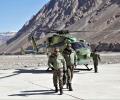
'This reluctance to respond forcefully to Chinese PLA provocations and outright aggression has as much to do with Prime Minister Modi personally, as with the institutional mindset of the MEA or even the Indian Army.' 'They are scarred by the 1962 War and are still cowed by China.'

The stand by China spelt out by its foreign ministry insisting that it takes the 1959 line on perception of the LAC amid a nearly five-month-long border standoff in eastern Ladakh triggered a strong reaction from India.
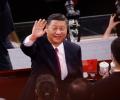
There is simmering disquiet in the Communist party and the world is watching as to what can unfold in China in the days to come ahead of next year's party congress, notes Rup Narayan Das.
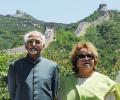
India and China have to narrow down differences and build on convergences by exploiting the potential of Panchsheel, the five principles of peaceful co-existence propounded by the two countries along with Myanmar in 1954, Vice President Hamid Ansari said on Saturday.

China has chosen to keep New Delhi guessing, while retaining for itself the option of constantly changing facts on the ground and shifting the LAC westwards -- the strategy called 'salami slicing', notes Ajai Shukla.
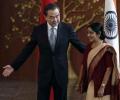
The entire gamut of bilateral ties including the contentious boundary issue was discussed during a "cordial and substantive" engagement between the foreign ministers of India and China in New Delhi who met within two weeks of installation of the Narendra Modi government.

'Xi's emphasis on enhancing conventional military deterrence capabilities, joint operations and power projection are likely to increase friction points with India as with other nations,' points out China expert Srikanth Kondapalli.

China on Wednesday accused India of "trampling" on the Panchsheel principles and asked New Delhi to "correct its mistakes" as soon as possible by pulling back troops.

'He is psychologically preparing the PLA and the Chinese public to avoid a loss of face.'

'Chinese troops are not geared to fight Indian troops who are battle hardened and acclimatised and are far more hardy.'

'Given the way in which the PLA operates today, I don't believe local commanders were necessarily acting without approval of higher levels.' 'They were acting in a way which they believed they were carrying out the intent of the higher levels.'

'China wants to change the status quo of India's Northern Border and proves that it can do whatever it wants in what it perceives as its own territory,' states Claude Arpi.

All the three issues raised by China at the Modi-Xi meeting are either intractable or peripheral to the bilateral relations and suggest conventional methods to placate the other side without yielding much, says Srikanth Kondapalli.
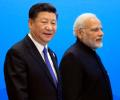
'There is a compulsion to look hard, decisive, and risk-taking; start something; and then conclude it in a way you can claim victory.' 'That is not such an easy option against China,' notes Shekhar Gupta.
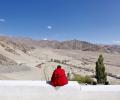
We should have anticipated it on August 5 last year, when we made the big changes in J&K. Amit Shah left nothing to chance when he told Parliament that 'we will bring back Aksai Chin even at the cost of our lives'. 'Then, there were the new maps, objections to the CPEC going through Indian territory, the weather reports.' A broad territorial status quo had existed in Ladakh-Aksai Chin since 1962. India made its intention to change this public, notes Shekhar Gupta.

It is well-known, and the Brooks-Bhagat report vouches for it, that the real failure for the 1962 debacle against China was not military, but political, says Ram Madhav.
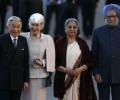
In recent years India-Japan relations have acquired rich economic content and strategic intents. Although the bilateral trade at $18 billion between the two countries is not very impressive and leaves much to be desired, the economic engagement between the two countries is both qualitatively and quantitatively noteworthy. India-Japan defence cooperation, however, has generated a lot interest among the strategic community in the context of rise of China. There has been a lot of speculation about India-Japan strategic partnership to hedge China, says Rup Narayan Das.

As of now, in the case of China's border dispute with India, China is not likely to lose much if it does not resolve the dispute. In fact, the unresolved border dispute has much to offer to China, says Sana Hashmi.

'In Chinese perception, India is strategically getting closer to United States and some Chinese analysts fear perhaps one day it may become a part of American arrangements against China.'

China's obsession with exports and electronics assembly can also be attributed to having learned from the Singaporean textbook.

'Does the Indian army's new assertiveness risk a clash escalating into shooting and possibly skirmishes?' asks Ajai Shukla.

We have our own problems for sure and they are not trivial, but for now, our economy is in not too bad a shape, our politics is as personality-driven and authoritarian as that of most countries in the world. We must make the best of what we have and not be excessively unhappy looking at the grass on the other side of the septic tank which may not be greener after all!, observes Shreekant Sambrani.

'One must remember that a dragon has a forked tongue,' warns Vivek Gumaste.

'R N Kao was a spymaster, an institution builder and a gentleman.'
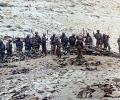
In fact, given the current tensions and massed troops on both sides, there is a danger that the LAC will become more like the Line of Control with Pakistan, a heavily fortified and strongly defended border where weapon fire exchanges regularly occur. Indeed, Stratfor Worldview research has listed a sharp increase in new Chinese facilities along the LAC in 2019-20.

Arpi deserves to be complimented for the commitment and hard work that have gone into this production. The frustrations of seeking reliable documentation from the catacombs of the Indian bureaucracy did not deter him from going after the best information available, and the result is one that he can take much satisfaction in. Ambassador Prabhat P Shukla, Member Advisory Council, Vivekananda International Foundation, reviews Claude Arpi's The End of an Era: India Exits Tibet.

The fiscal deficit of the Centre remains a worry, running at over 6.5 per cent of GDP in April-September 2014, mainly because of revenue shortfalls from exaggerated projections in the government's July Budget and despite the relief on subsidies from lower oil prices.

Outlining seven principles of engagement for closer cooperation between India and China, Prime Minister Manmohan Singh on Thursday said the two countries should show sensitivity to each other's interests and sovereignty and move quickly to resolve the boundary issue.

India and China on Wednesday signed in all nine agreements, including the Border Defence Cooperation Agreement and one on strengthening cooperation on trans-border rivers, after restricted and delegation-level talks that lasted over two hours as Prime Minister Manmohan Singh and Premier Li Keqiang met for the second time this year for talks which the Indian leader described as "fruitful and productive".

'Galbraith had a powerful ally in Washington -- not as blunt and direct as the ambassador -- but committed to see Krishna Menon go.' 'This was President Kennedy himself.'

If the chemistry between Modi and Xi Jinping goes well, it will herald a new future not just for the region but for the world, says Tarun Vijay.

Though the Chinese find it necessary to oppose the visits of Indian leaders to Arunachal Pradesh, they want to keep the objections at a moderate level lest it cast a shadow on Narendra Modi's visit to China in May, says D S Rajan.

Very few today realise that without Brigadier John Dalvi's courage, we would never have known what really happened during those tragic days of October/November 1962, reveals Claude Arpi.

Can you find a world leader who has met generations of Indian politicians, most US Presidents, European head of States, several Popes, celebrated cricketers, Hollywood and Bollywood stars, some of the greatest scientists and many ordinary people, including what he calls, 'Chinese brothers and sisters?'

Following is the full text of Prime Minister Manmohan Singh's speech at the Central Party School in Beijing on Thursday:
